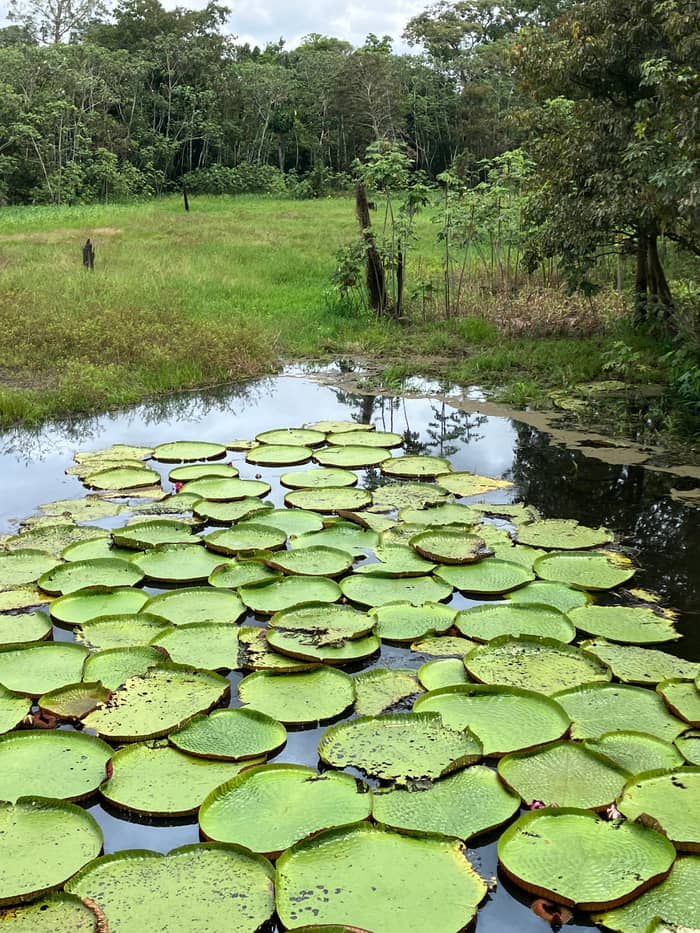
First visit
The full day
Boat, canoes, village, lunch
- Length1 day
- GuideIn English
- Fromfrom $55
Guides
Language
Currency
See what is openfrom $55 · cancelling is freeDeciding made easy
The quick version
The Amazon River is important because it carries nearly 20 percent of the Earth's discharge into the oceans, drains the most biologically diverse river basin and is a road for millions of people.
Key numbers
Two taps to a river trip
Say how much time you have and what you most want to see, and the matching trip appears with its price.
Best match for you
from $55
It reaches the Meeting of the Waters by boat.
Best match for you
from $150
It lasts 8 hours in the Anavilhanas archipelago.
Best match for you
from $90
It lasts 5 hours, in a small group.
Best match for you
from $420
It includes a night on the river.
The Amazon is not the longest river by every count, but it carries more fresh water than any other. Here are its length, source, mouth and character, with each figure tied to its source.
Editorial team, amazonrivertour.quest · Updated November 12, 2026 · 8 mins to read
Numbers about the Amazon depend on who measures. The Amazon Cooperation Treaty Organization says the river runs more than 6,992 km from its source in Peru through the geography of eight countries to the Atlantic Ocean in Brazil.1 NASA, describing the river's course across Brazil, says it flows more than 6,450 kilometers eastward.5 Those figures differ because they count different stretches and different sources, not because one of them is wrong.
The basin is the other big number. Its basin spreads over more than 6.1 million km2, the equivalent of 44% of South America's land, and the treaty organization adds that the basin sends 15-20% of the world's liquid fresh water into the Atlantic.4,6 NASA frames the share a little differently: no river moves more fresh water, and the Amazon alone supplies nearly 20 percent of what Earth's rivers pour into the oceans.2
Rain feeds it generously, with 200 mm a year on the Andean side and over 6,000 mm in parts of the plains.7 That wide range explains how a river that begins as thin mountain streams can end as a sea-sized flow, and why its floods and low waters are so dramatic. Those numbers give the river its reputation for abundance. If you remember a single figure for a quiz or a school project, make it the share of the world's discharge, because that is where the Amazon stands out.
The numbers compared
| Source | What it says | Figure |
|---|---|---|
| Amazon Cooperation Treaty Organization | Length from source to Atlantic | More than 6,992 km1 |
| NASA, river course | Flow across Brazil | More than 6,450 km5 |
| 2007 Brazilian estimate | Amazon length | 6,800 km14 |
| 2007 Brazilian estimate | Nile length | 6,695 km14 |
| Treaty organization | Share of world freshwater | 15-20%6 |
| NASA | Share of ocean discharge | Nearly 20 percent2 |
The sources measure different things, which is why the figures differ.15
The Amazon starts in the Andes of Peru, in high mountains far from any city or road a visitor would normally use. In NASA's telling, the river is born in the Peruvian Andes as small mountain streams that merge into one of the mightiest rivers anywhere.3 The treaty organization agrees that the journey begins at a source in Peru.1 Which stream counts as the source, though, is a real question.
In 2007 a team of Brazilian researchers challenged the older belief that the river begins in northern Peru.12 The team claimed the river originated instead in southern Peru, somewhere on snowcapped Mount Mismi, also called Nevado Mismi.13 The distinction matters because the choice of source changes the river's length, which brings back the old debate with the Nile, and shows how a question that sounds simple can depend on a patient field expedition.
For a traveler the debate is mostly a curiosity, since no visitor from Manaus goes near the source. It still helps to know that any length you hear on a boat is an estimate with a story behind it. A guide who tells you the length is exact is rounding, and the honest version is that length depends on identifying the source, a point that never fails to impress a quiet table of listeners.
By the traditional count, no, and the textbooks have said so for a long time. NASA says the Nile is longer, yet no river moves more fresh water than the Amazon.2 Opinion has not stayed fixed, though, and the 2007 Brazilian estimate changes the comparison: it put the Amazon at 6,800 kilometers and the Nile at 6,695 kilometers.14 On that estimate the Amazon is the longer river, by a small margin.
NASA stresses that the question has no final answer, and that careful scientists can disagree in good faith. It says a river's exact length is hard to pin down, partly because the answer hinges on where the source is placed.15 The Amazon Cooperation Treaty Organization's more than 6,992 km, quoted above, is a further figure from a further source, and it shows how far the numbers can drift when different people count the same river.1
So the safe answer for a visitor is a pair of statements. The Amazon is the largest river in the world by volume of water, as NASA says. By length it comes first or second, depending on the count. Either way, it is far larger than anything else you will cross by boat, and the Nile comparison is a good opening for a conversation with your guide on the way to the village landing or the lake.
Meet the river
First visit
Boat, canoes, village, lunch
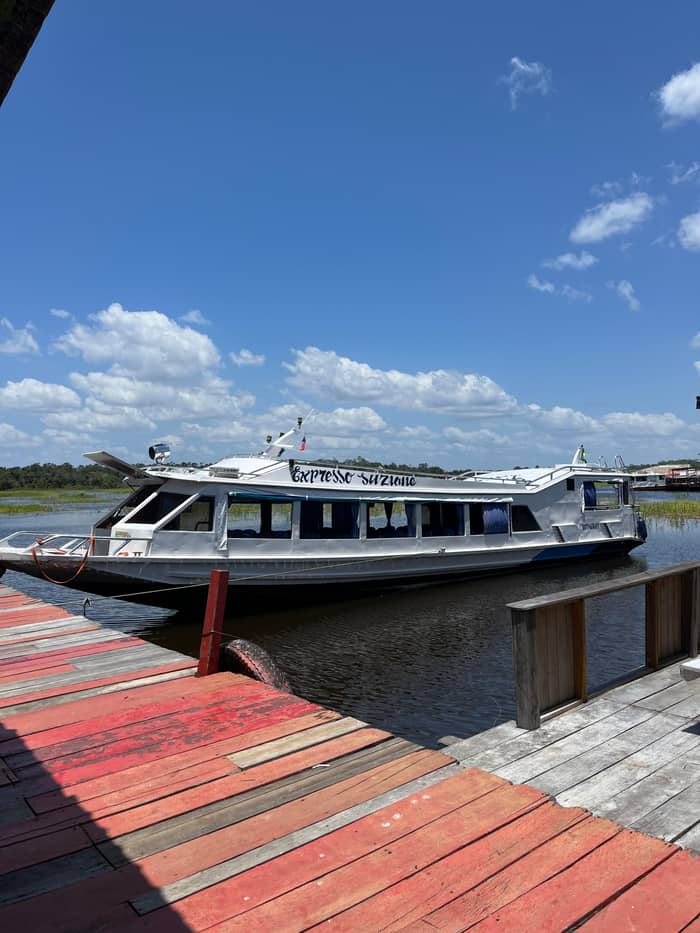
Shorter
Rivers with a local guide
Longer
A night on the Rio Negro
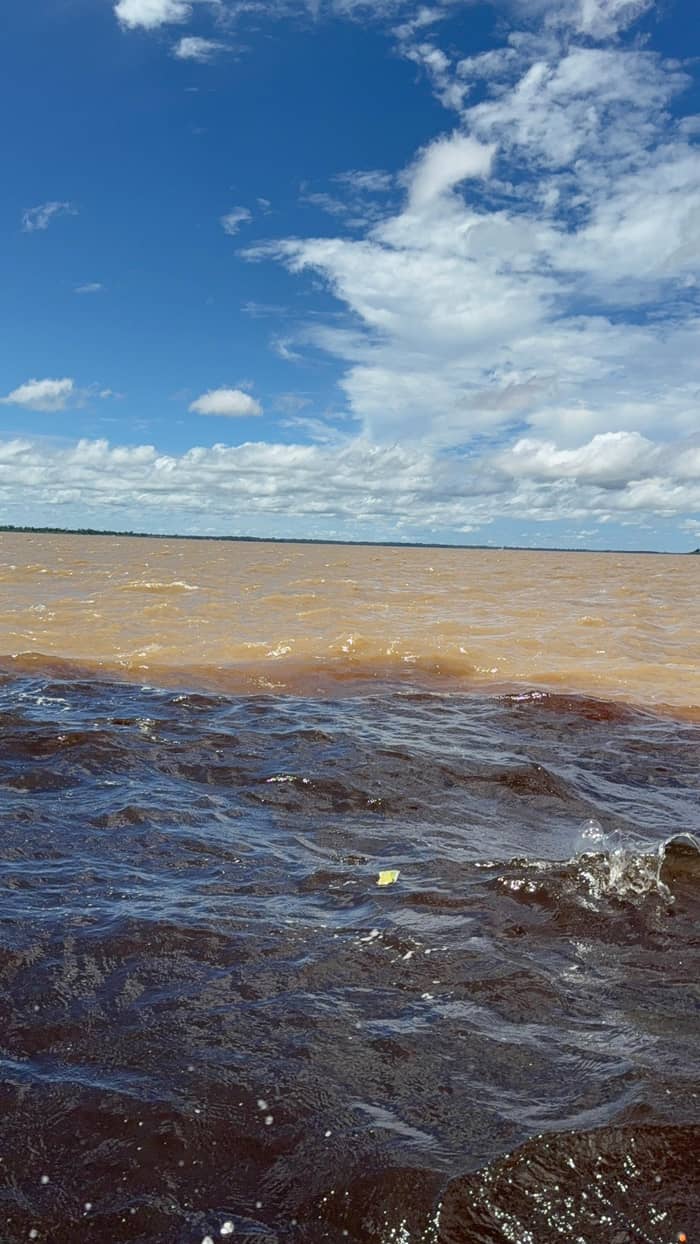
The Amazon is not a single river of a single color. It changes name, color and character as it flows, and Manaus is where that change is easiest to see. At Manaus the Solimões, the upper Amazon, is joined by the Negro, and NASA treats that junction as the birthplace of the Amazon.10 Upstream of that meeting the main stem is called the Solimões in Brazil, which is why Manaus guides treat the Solimões and the Negro as separate rivers until the confluence.18
Its water changes character along the way, which is the first thing a visitor on the Manaus waterfront notices. The Solimões gets its tan color from Andean sediment and is the shallower of the pair, having silted up its own valley.19,20 The Negro, by contrast, is stained black-tea brown by organic matter from the forest floor.21 NASA's confluence image shows the Negro almost 20 km wide in one corner, wider than most visitors expect of a river.22
It swells and shrinks with the seasons, and the change is large enough to redraw the shoreline. The flood peaks from May to July, when the water climbs several meters, according to NASA.16 The gauge at the Manaus port has logged anything from 13.63 meters to 29.77 meters over the years.23,24 A river with that range changes the landscape twice a year, and it is one reason the same tour looks different on different dates.
Meet the river
Pick how long you want to spend on the river and read off the price for your group.
Look at 3 options
Pick how long you want to spend on the river and read off the price for your group.
≈
View≈
View≈
ViewStarting prices as on the booking platform, converted at the ECB reference rate. You see the exact price at booking.
Source to sea
The start
Tiny mountain streams combine.3
Upper river
Peru's departure point for river journeys.8
The border
The Solimões is read here by Brazil's survey.9
The confluence
The Negro joins the Solimões and the Amazon takes its name.10
Downstream
A ferry of 36 hours from Manaus.
The mouth
Water empties into the sea every second.11
Water comes first. The basin sends 15-20% of the world's liquid fresh water into the Atlantic, and the treaty organization adds that it is a key player in the global water and carbon cycles and a natural regulator of climate.6,25 That role is why changes in the basin attract attention far beyond the countries it flows through, and why scientists watch its water and forests so closely.
Life is the next reason. The organization calls the Amazon Basin the most biologically diverse river basin in the world, with about 3,000 species of fish.26,27 NASA adds that floodplain lakes fed by the muddy Solimões have a different ecology from blackwater waters, which is part of why such a diversity of habitats exists, from open floodplain to forest that stands in water for months.28
People are the last reason, and the most immediate one. The basin is home to about 48.5 million people, with the population urbanizing quickly, according to the treaty organization.29 Peru's tourism board describes the river as a main route of communication for millions, and NASA sees Manaus as the chief transport hub upriver.30,31 In a region with few roads, a river is not scenery; it is the infrastructure.
Video
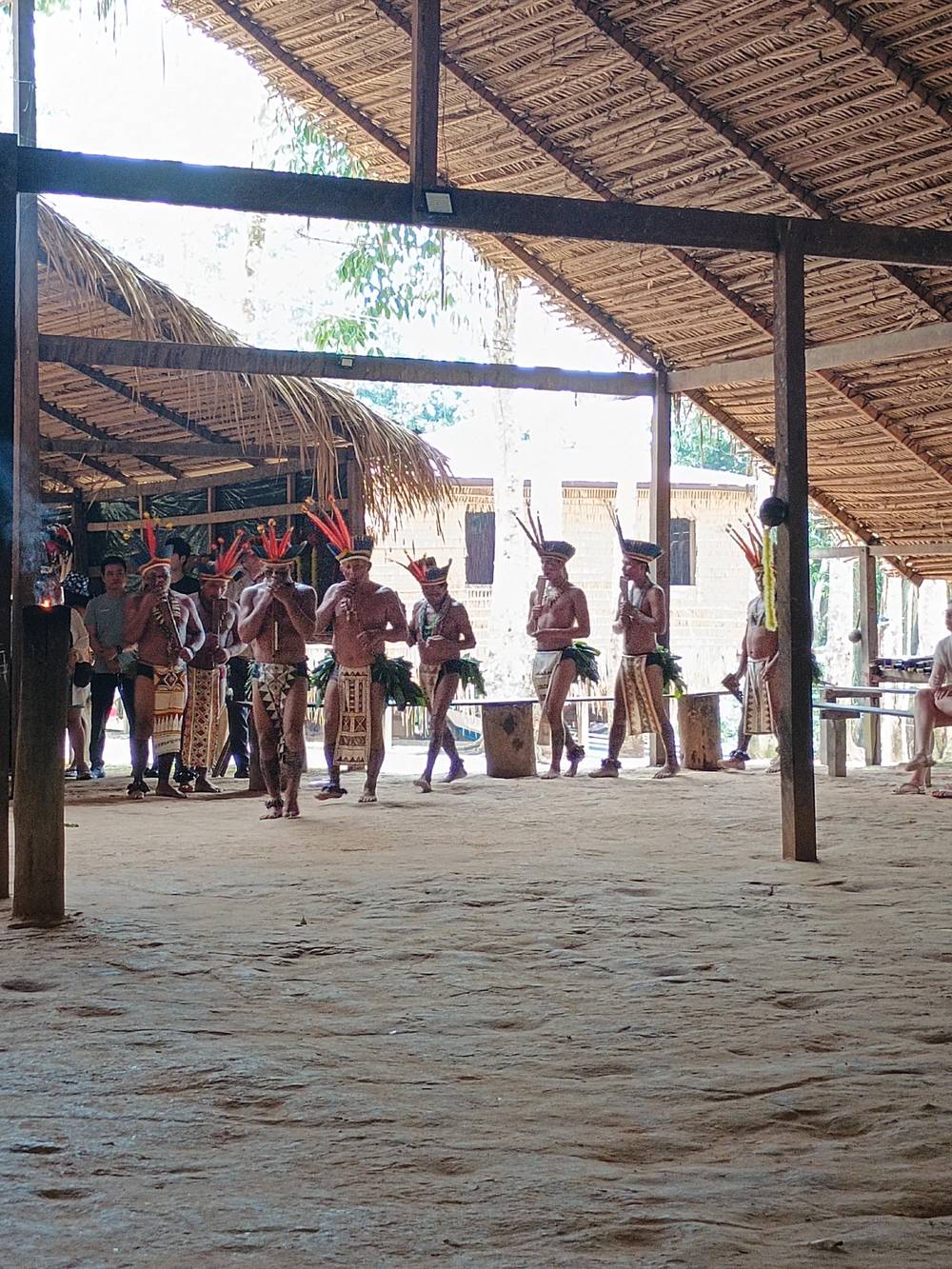
DW Documentary on YouTube · Until you tap play, no video is loaded.
assessing the exact length of a river can be difficult, and the calculation depends partly on identifying the river’s source
Use the numbers well
The river reaches the Atlantic Ocean in Brazil, as the treaty organization puts it, after crossing the whole width of the continent.1 NASA reports millions of cubic feet of water entering the Atlantic each second, with the outflow carried a very long way from the shore.11 The mouth is so wide and the flow so strong that river water reaches far out to sea, which is how a river can leave its mark on the ocean it joins.
The mouth is also where the river's reputation ends and its scale becomes obvious. The same NASA page grants that the Nile is longer, but the Amazon moves the most fresh water of any river, nearly 20 percent of Earth's discharge into the oceans.2 The comparison is simple: a longer river does not mean a bigger river, and the Amazon is the clearest example, with the Nile the usual counterpoint.
A short boat trip from Manaus will not take you to the mouth, which lies far downstream, but a ferry of 36 hours reaches Santarém while Belém is a 5-day journey by local boat, both listed from Manaus as transportation rather than sightseeing. For most visitors, the mouth stays an idea, and the Meeting of the Waters at Manaus is the place where the river becomes real, close enough to touch and easy to reach in a single day.
Who owns the river? No one does. Eight countries are members of the Amazon Cooperation Treaty Organization, which brings them together to manage the basin.32 The Brazilian government counts nine countries in the Amazon biome, adding French Guiana to the list.33 The river itself flows through them without regard to borders, so a boat trip in Brazil can feel like a lesson in how many nations share one waterway.
A river or a system? Both. NASA treats the Amazon as a single river that forms at Manaus, but the basin contains many other rivers, from the black Negro to the clear Tapajós and the white Solimões.10,34 The treaty organization also points to pollution as one of the nine critical problems of the basin, which is a reminder that the world's greatest river has real-world pressures that visitors can help by choosing responsible operators and carrying their rubbish out.35
Can you drink from it? No: official advice for Brazil is boiled water or sealed bottled water, and the river's color tells you nothing about its safety.17 What you can do on a visit is meet the river from a boat, which is the point of the tours listed here, and the best preparation is a sealed bottle, a hat and a little curiosity about why the water looks the way it does, which is exactly the question this page set out to answer.
FAQ
NASA says it originates there as tiny mountain streams.3
A 2007 Brazilian estimate put the Amazon at 6,800 kilometers and the Nile at 6,695 kilometers.14
The river reaches the Atlantic Ocean in Brazil.1
NASA says the Amazon forms from their confluence at Manaus.10
Sources
Heading for the Amazon? Ask a real person here.